
Introducing the CXO ESG-Aligned AI Playbook Artificial Intelligence is driving an unprecedented revolution across industries globally. Business leaders are jumping on the AI bandwagon to optimize their business operations. These leaders must, however, make sure that their AI models and systems adhere to Environmental, Social, and Governance (ESG) norms. As a CXO ESG-Aligned AI Playbook, […]
Artificial Intelligence is driving an unprecedented revolution across industries globally. Business leaders are jumping on the AI bandwagon to optimize their business operations. These leaders must, however, make sure that their AI models and systems adhere to Environmental, Social, and Governance (ESG) norms.
As a CXO ESG-Aligned AI Playbook, this piece provides executives with a strategy approach for incorporating ESG considerations into AI development and implementation, guaranteeing sustainability, equity, and long-term value generation.
Sustainable Intelligence or ESG-aligned AI refers to the responsible designing, development, and deployment of intelligent systems such as Machine Learning (ML) and Artificial Intelligence (AI) that keep long-term environmental, social, and ethical sustainability at the forefront of all development. The foundation of the pursuit of sustainable intelligence is the need to reduce harm, advance fairness, and conform to international Environmental, Social, and Governance (ESG) standards.
Integrating ESG principles into AI is no longer optional—it’s a necessity. Leading organizations like Google and Microsoft are trailblazing ESG efforts in the tech industry by committing to carbon-neutral AI development and ethical AI governance practices. Microsoft1 has resolved to become carbon-negative by 2023. Google2 also strives to achieve net-zero emissions and 24/7 carbon-free energy by 2030 across all its operations and value chains.
Many challenges stand in the way of incorporating ESG principles into AI models and systems. To ensure the responsible and sustainable deployment of AI, businesses must effectively manage these issues.
Environmental Challenges: AI model development and implementation use a lot of energy, which exacerbates environmental problems. Furthermore, a substantial amount of energy is used to train models such as ChatGPT3, which raises carbon emissions.
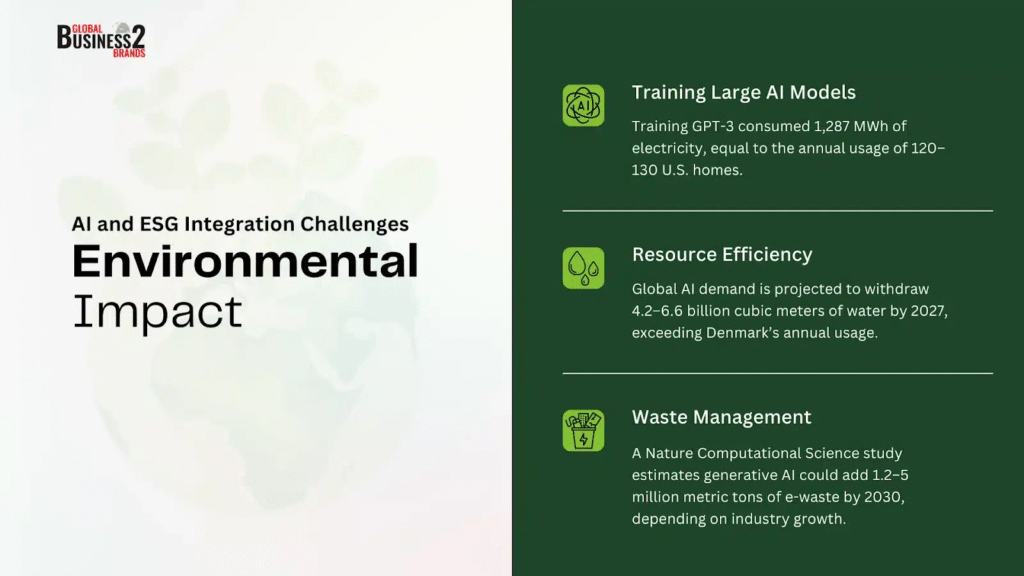
Companies should strive for environmental sustainability in AI, by:
Ethical AI should prioritize fairness and inclusivity, by:
CXOs should spearhead the maintenance and adoption of ethical AI governance in organizations, by:
ESG metrics use ESG issues to measure performance. They assist your company in accurately and scientifically assessing the results of your ESG initiatives. The definitions and regulations around ESG are constantly evolving so one wouldn’t find universal metrics. However, organizations like the World Economic Forum5 are trying to create a common metric for consistent reporting.
Here are a few key metrics for CXOs to consider:
| 📊 Carbon Footprint Reduction – Lower AI-related energy consumption. |
| 📊 Diversity in AI Training Data – Ensure representation across all demographics. |
| 📊 Regulatory Compliance Score – Adhere to evolving AI ethics laws. |
The substantial amount of energy consumption in AI systems and models development and training is indubitably a palpable concern. CXOs at the helm of the AI revolution must integrate ESG principles for long-term sustainable benefits. Remember, in light of growing environmental awareness, ESG compliance is imperative for major businesses.
Only by prioritizing sustainability, fairness, and governance, Organizations can unlock ethical innovation, enhance trust, and drive long-term success in the AI-driven world.
1. https://blogs.microsoft.com/blog/2020/01/16/microsoft-will-be-carbon-negative-by-2030/
2. https://sustainability.google/operating-sustainably/net-zero-carbon/
5. https://www3.weforum.org/docs/WEF_IBC_Measuring_Stakeholder_Capitalism_Report_2020.pdf
Browse our full library of articles, reports, and resources.
