Scope 1, 2 & 3 Emissions: Navigating Corporate Carbon Footprints
Introduction
Understanding Scope 1, 2, and 3 emissions is essential for businesses aiming to manage their environmental impact. These categories provide a clear framework for identifying where emissions originate, both within operations and across the value chain. By breaking emissions down in this way, organizations can set meaningful reduction targets, track progress, and contribute more effectively to global climate goals.
The GHG Protocol Corporate Standard, developed by the World Resources Institute (WRI) and the World Business Council for Sustainable Development (WBCSD), provides a standardized framework for measuring and reporting GHG emissions, covering seven gases listed in the Kyoto Protocol (CO2, CH4, N2O, HFCs, PFCs, SF6, and NF3).
The protocol classifies a company’s GHG emissions into three ‘scopes’ — Scope 1, Scope 2, and Scope 3 for corporate-level emissions inventories. These GHG emissions are released across a company’s entire value chain.
Here’s a simple classification of the three, before we get into their complexities to understand how Scope 3 emissions are different from Scope 1 and Scope 2 emissions.
- Scope 1: Direct emissions from owned or controlled sources (e.g., company vehicles, on-site fuel combustion).
- Scope 2: Indirect emissions from purchased electricity, steam, heat, or cooling.
- Scope 3: Other indirect emissions across the value chain (e.g., supply chain, employee commuting, product use), as detailed in the Corporate Value Chain (Scope 3) Standard.
Scope 1 and Scope 2 Emissions Explained:
Scope 1 emissions come from sources the company directly controls (like its vehicles), while Scope 2 emissions are tied to purchased energy used by the company but generated elsewhere.
Scope 3 Emissions Explained: What makes them complex?
Scope 3 emissions are all indirect emissions that are not included in Scope 2 that occur in a company’s value chain, both upstream and downstream, but are not directly owned or controlled by the company. These are often the largest and most complex category of emissions to measure and manage.
Key Categories of Scope 3 Emissions
The GHG Protocol’s Corporate Value Chain (Scope 3) Standard outlines 15 categories, including:
- Upstream: Purchased goods and services, business travel, employee commuting, transportation and distribution (e.g., shipping raw materials).
- Downstream: Use of sold products, end-of-life treatment (e.g., disposal/recycling), transportation and distribution of sold products.
The production cycle phases typically include raw material acquisition, manufacturing/processing, distribution, use, and end-of-life. The table below outlines how Scope 1, 2, and 3 emissions align with these phases, with examples specific to the metal parts manufacturer.
| Production Cycle Phase | Scope 1 Emissions | Scope 2 Emissions | Scope 3 Emissions |
| Raw Material Acquisition | None (company does not directly control raw material extraction). | None (no purchased energy in this phase). | Supplier raw material extraction & processing (e.g., steel production emissions). |
| Manufacturing/Processing | Emissions from on-site fuel use, e.g., natural gas for factory furnaces. | Emissions from purchased electricity for factory machinery. | Emissions from outsourced manufacturing processes or employee commuting to the factory. |
| Distribution | Emissions from company-owned delivery trucks. | None (distribution typically does not involve purchased energy). | Third-party logistics, outsourced shipping. |
| Use | None (company does not control product use). | None (no purchased energy in this phase). | Customer use of products (e.g., electricity consumed by appliances). |
| End-of-Life | None (company does not manage disposal). | None (no purchased energy in this phase). | Recycling, disposal, or treatment of sold products. |
Note: Emission sources shown align with each production phase and emission scope. Actual greenhouse gas values (e.g., CO2) depend on specific fuels, electricity grid factors, and detailed lifecycle data.
Why Scope 3 Matters ?
Scope 3 emissions often account for the majority of a company’s carbon footprint (sometimes 70-90%) but are harder to measure due to reliance on external data from suppliers, customers, and partners. For example, a company’s direct emissions (Scope 1) and electricity use (Scope 2) might be small compared to emissions from its supply chain or product use.
GB2B offers advisory services, helping your organization with comprehensive measurement and reporting of greenhouse gas emissions.
Conclusion
The path to Net Zero is clear but challenging, requiring comprehensive action across all emissions scopes. By leveraging the GHG Protocol’s Scope 1, 2, and 3 framework, organizations can quantify their carbon footprint, address value chain impacts, and lead the charge toward a sustainable future. Collective commitment to these standards will turn our climate ambitions into reality.
The Corporate Race to Net Zero
The Corporate Race to Net Zero
The race to net zero—the eradication of carbon footprint—must not be seen as a competition but as an all-for-one agenda to benefit humanity. With only 25 years left to fulfill an ambitious yet necessary goal, one of the questions worth asking is: are organizations and businesses ready to commit and fulfill their promises in time, or will it simply be business-as-usual?
What is ‘Net zero’?
Simply put, net zero emissions refer to balancing the amount of greenhouse gases emitted into the atmosphere with the amount removed through carbon sequestration. The concept of net zero is crucial because, at this point—specifically for carbon dioxide—global warming ceases to increase. The Paris Agreement emphasizes the necessity of reaching net zero, mandating that countries must “establish a balance between human-caused emissions from sources and the removal of greenhouse gases through sinks during the latter half of this century.” The science is clear: global carbon dioxide emissions must be slashed by nearly half by 2030, and we must reach net-zero emissions by 2050 to limit global warming to 1.5°C above pre-industrial levels. The Net-Zero Coalition, supported by the United Nations, emphasizes that relying solely on offsets without deep decarbonization of business practices will not be enough. In short, net zero cannot be a mere accounting trick—it requires a fundamental transformation.
Implementing the Net Zero Agenda
The net zero agenda was not only driven by the escalating climate crisis but also by economic pressures, societal expectations, and shifting regulatory requirements. However, beyond mere compliance, this agenda must be taken seriously and urgently: the impact of climate change on our everyday lives is no longer a hypothetical threat but an observable reality due to the frequency and severity of natural disasters that we experience every year. From global warming, melting ice caps, and rising sea levels as direct consequences from one to the other, the consequences are catastrophic for both natural ecosystems and human societies.
In recent years, several multinational corporations have set ambitious net-zero targets. Tech giants, fashion brands, energy companies, and banks have all jumped onto the trend of sustainability, promising to decarbonize their operations. Governments have supported these efforts through legislative frameworks, such as carbon pricing and stricter emissions regulations, creating an environment where sustainability is not just an option but a necessity.
The strategic rationale for net zero is compelling: companies are increasingly recognizing that climate risks are financial risks. Disruption from extreme weather events, resource scarcity, and shifting consumer expectations threaten to undermine long-term business models. According to a 2023 report by Accenture, companies that actively work to reduce emissions could unlock an estimated $4.5 trillion in new economic opportunities by 2030, driven by energy efficiency, supply chain innovations, and the rise of green products.
Since the business sector contributes significantly to global emissions, accountability is a must, and recognizing their pivotal role in the shift toward a sustainable future becomes instrumental. In a report by the Carbon Disclosure Project (CDP) in 2017, 71% of global industrial GHG emissions come from 100 global companies alone. While many companies have made commitments, the execution of these promises is fraught with challenges and inconsistencies.
Navigating the Challenge of Greenwashing
The challenge of net zero is the challenge of greenwashing which is no longer new: many critics argue that corporate net-zero commitments often lack transparency, clear action plans, or robust accountability mechanisms. This phenomenon erodes trust and undermines genuine climate efforts. For example, some companies claim progress by shifting emissions off their balance sheets, outsourcing carbon-intensive operations, or using unverified carbon offsets that offer little real-world impact. To avoid such, rigorous and transparent reporting and strict adherence to global reporting standards (such as, but not limited to, ISO 14064 and GHG Protocol Standards) becomes important. Second, stakeholders—including consumers, investors, and regulators—must hold corporations accountable, demanding evidence of meaningful action rather than empty promises.
The Importance of Innovation and Collaboration
Corporate strategies for net zero are becoming more sophisticated as many organizations are investing in technological innovations, such as carbon capture and storage, electrification of fleets, and the development of circular supply chains. Collaboration is also crucial: no single company can achieve net zero alone. Partnerships across industries and with governments, non-governmental organizations (NGOs), and the academe are necessary to scale solutions. Firms like Microsoft and Unilever are leading examples of cross-sector collaboration, investing in renewable energy projects, and sharing carbon reduction technologies. However, widespread change will require systemic collaboration, not isolated acts of corporate responsibility. That means rethinking how entire value chains operate and how global markets can facilitate the net zero transition.
Future Actions for CXOs
Despite progress, time is of the essence and mostly not on our side. Every year of inaction or insufficient action locks us into higher temperatures and deeper climate crises. The corporate race to net zero must be both accelerated and scrutinized. Four key things must happen to achieve our goals as humanity:
- Commit to Science-Based Targets: Businesses should align with the Science-Based Targets initiative (SBTi) to ensure their goals are consistent with limiting global warming to 1.5°C.
- Prioritize Transparency and Accountability: Corporate leaders should adopt clear reporting standards, make data accessible to stakeholders, and welcome independent verification.
- Invest in True Innovation: The road to net zero requires massive investments in technology, R&D, and infrastructure that genuinely reduce emissions.
- Engage Stakeholders Across the Board: Governments, investors, and consumers must continue to push corporations toward meaningful climate action.
It is worth noting that the corporate race to net zero is nonetheless an opportunity to redefine business success in alignment with planetary and societal boundaries. Success will require an unwavering commitment to scientific principles, technological innovations, effective regulations, and an inclusive approach that prioritizes equity and resilience. As corporations deepen their role in this global transition, they stand not only to mitigate risk but to pioneer a new era where sustainable impact becomes the ultimate measure of achievement.
Synopsis: Key Insights and Takeaways
1. Insights:
- The Net Zero Imperative: A call for companies to balance greenhouse gas emissions with removal strategies by 2050 to keep global warming below 1.5°C.
- Business Incentives: Achieving net zero is financially rewarding; studies show it could generate over $4.5 trillion in economic opportunities by 2030.
- Strategic Priorities: Moving beyond mere compliance, embracing rigorous transparency, and engaging in true innovation to secure climate commitments.
2. Learnings:
- Deep Decarbonization: Cutting emissions drastically, not relying solely on offsets, is essential to meeting long-term climate goals.
- Combatting Greenwashing: Genuine impact demands transparent, verified reporting standards like ISO 14064 or the GHG Protocol.
- Collaboration as a Catalyst: Partnerships across industries and with governments amplify efforts, setting the stage for systemic change.
3. Future Actions for CXOs:
- Set Science-Based Targets: Align corporate goals with the Science-Based Targets initiative for credibility and impact.
- Invest in Innovation: Prioritize R&D in carbon capture, renewables, and low-carbon infrastructure.
- Engage Stakeholders: Collaborate with policymakers, NGOs, and consumers to drive authentic climate action.
The ESG Data Challenge: Enhancing Transparency and Accuracy in Corporate Sustainability Reporting
The ESG Data Challenge: Enhancing Transparency and Accuracy in Corporate Sustainability Reporting
At present, the term ‘buzzword’ could no longer suffice in describing Environmental, Social, and Governance (ESG) and Sustainability frameworks—transcending such trend, these are becoming tenets of operational strategy and investor decision-making for long-term viability and genuine corporate accountability.
Investors, consumers, and regulatory bodies are increasingly holding companies accountable for their environmental and social impacts, driving demand for reliable, transparent, and accurate sustainability reporting. However, as the significance of ESG data intensifies, how can companies overcome the current data challenges to deliver credible and comprehensive ESG reports?
The Importance of Transparent and Accurate ESG Data
A transparent ESG report gives stakeholders the confidence that a company’s disclosures reflect reality rather than aspiration—a tool for assessing a company’s impact and progress in managing environmental and social risks. However, achieving this level of transparency is no small feat. Companies must adopt comprehensive data strategies and measures to improve the quality and trustworthiness of their ESG metrics in order to reassure the public that a company’s sustainability claims are genuine.
For ESG data to be meaningful, companies must ensure it is consistent, reliable, and relevant: without transparency, sustainability claims can easily fall into the trap of greenwashing, eroding trust and exposing companies to reputational and regulatory risks.
On the other hand, when companies prioritize accuracy and clarity in their ESG disclosures, they create a powerful narrative that resonates with stakeholders and drives informed decision-making. Transparent reporting doesn’t merely paint a picture of current performance but rather a commitment to driving progress while ensuring a more sustainable future.
The Problem: Inaccurate and Lack of Clear-cut Frameworks and Methodologies
The current ESG reporting landscape is a maze of fragmented standards and inconsistent methodologies, creating significant barriers to effective corporate sustainability assessment. Although frameworks like the Global Reporting Initiative (GRI), Sustainability Accounting Standards Board (SASB), and the Task Force on Climate-related Financial Disclosures (TCFD) provide guidance, the lack of universal alignment results in more confusion than clarity. The present situation is that companies often find themselves navigating a patchwork of requirements, leading to reports that vary widely in content and quality.
Such creates a data environment that lacks standardization, making ESG information less actionable and more susceptible to skepticism. Investors are left grappling with incomplete or non-comparable data, while companies struggle to demonstrate their sustainability progress in a credible way. Until there is greater harmonization and coherence in reporting standards, the effectiveness and trustworthiness of ESG disclosures will remain compromised. To truly advance sustainability, the focus must shift to developing a more unified and transparent framework that enables companies to report ESG metrics in a consistent, comparable, and reliable manner.
Strategies for Companies to Improve Corporate Sustainability Reporting
The regulatory landscape for ESG reporting is becoming more stringent. The Corporate Sustainability Reporting Directive (CSRD) in the European Union, for example, mandates standardized and audited sustainability reporting. This is a significant step forward, but global alignment remains a challenge.
Regulators worldwide are increasingly recognizing the need for cohesive ESG disclosure standards. While this regulatory push can drive better data practices, companies must proactively prepare by establishing rigorous internal reporting mechanisms and ensuring compliance with emerging standards.
Despite the lack of clear-cut methodologies, companies (at least those without stringent regulatory measures unlike the EU), must take matters into their own hands and go beyond what is required and asked from them, to truly advance sustainability which necessitates accurate, transparent, and verifiable data. A couple of action steps are outlined below:
1. Technological Integration
Data integration platforms, like those discussed by industry leaders, provide end-to-end visibility into ESG metrics across complex supply chains. These platforms allow for real-time data collection, reducing the risk of discrepancies and human error. As a result, companies can improve the integrity of their sustainability reports, giving stakeholders greater confidence in the data presented.
2. Robust Governance and Accountability
Technology alone cannot solve the ESG data problem. Strong governance frameworks are essential to ensure that data collection, management, and reporting processes are ethical, unbiased, and transparent. Furthermore, sustainability must be embedded into the corporate culture, with accountability starting at the top: executive leadership should prioritize ESG performance and integrate it into the broader strategic goals of the organization.
3. Internal Audits and External Assurance
This dual approach—combining the detailed oversight of internal audits with the impartial assessment of external assurance—ensures that ESG data is not just accurate but robust and defensible, thereby enhancing the company’s overall transparency and verifiability of reports.
The Path Forward
Ultimately, the companies that prioritize integrity and accuracy in their ESG reporting today will be the ones shaping a sustainable and thriving future tomorrow. The path forward is clear: embrace transparency, invest in robust data practices, and commit to continuous improvement. The rewards—both for the company and for the planet—are too significant to ignore.
The NEW Crypto-Asset Reporting Framework: A Step Towards International Coordination in Regulating the Crypto Industry
Introduction
The emergence of cryptocurrencies in the early 21st century sparked a debate about their classification as money. Traditionally, money is defined by its five functions: unit of account, medium of exchange, means of payment, standard for deferred payments, and store of value. While cryptocurrencies can satisfy the first three functions, their inherent volatility limits their effectiveness as a standard for deferred payments and a store of value. Consequently, except for El Salvador, cryptocurrencies are not recognized as money or legal tender across most jurisdictions. Nevertheless, there is a growing consensus that they can be categorized as an asset class.
The Cockroach Theory of Crypto
The crypto industry has posed significant challenges for regulators and central banks. The rapid cross-border reach and swift trading capabilities of cryptocurrencies make them susceptible to illicit activities such as money laundering, terrorism financing, tax evasion, and financial scams. In decentralized peer-to-peer transactions, customer identities are often obscured, complicating the tracing of illicit activities. Even on centralized platforms, crypto-service providers may not be required to disclose customer identities or perform Know Your Customer (KYC) checks.
This issue is compounded when illicit transactions cross international borders, making coordinated international regulatory collaboration essential. As noted in a December 2023 Economist article, the crypto industry is akin to cockroaches—resilient and difficult to eradicate, even under intense scrutiny. Despite regulatory attempts to stifle it, cryptocurrencies continue to thrive, largely due to the innovative blockchain technology underpinning them.
Crypto Assets Go Mainstream
The volatility of cryptocurrencies was starkly illustrated when Bitcoin, the largest cryptocurrency, peaked at nearly $69,000 in November 2021 but plummeted to around $16,600 by early 2023. This decline was influenced by rising interest rates and a series of scandals involving major crypto exchanges like Binance and FTX, whose founders faced legal consequences for anti-money laundering violations and fraud—issues not exclusive to the crypto sector.
However, 2023 marked a turning point as crypto assets began to solidify their status as a legitimate asset class. A pivotal moment came when a U.S. court mandated the Securities and Exchange Commission (SEC) to reconsider Grayscale’s application to convert its $17 billion Bitcoin trust into an exchange-traded fund (ETF). Major asset managers like BlackRock and Fidelity also sought to launch crypto asset ETFs, enhancing optimism about regulatory approval.
By the last quarter of 2023, Bitcoin’s price surged to nearly $45,000, a remarkable 150% increase over the year. On January 10, 2024, the SEC approved the trading of spot Bitcoin ETFs, although it was made clear that this approval did not extend to endorsing Bitcoin itself. Emphasizing this point, the SEC Chair, Gary Gensler, stated: “While we approved the listing of certain bitcoin ETF shares today, we did not approve or endorse bitcoin. ”Following this development, Bitcoin’s value rose above $46,000 and surpassed $60,000 by October 2024. According to a report from The Daily Hodl on October 28, 2024, BlackRock had amassed over 403,725 BTC, valued at more than $26 billion, in its iShares Bitcoin Trust ETF.
On 5 November 2024, the USA held presidential elections. The victorious president who will be inaugurated on 20 January 2025, Ronald Trump, is pro-crypto. Following his victory, the crypto market responded positively with the price of bitcoin hovering near the $100 000 at the end of November 2024. To cap it all, the present Chair of SEC, Gary Gensler, will be succeeded by a pro-crypto chair in 2025.
([1] See https://www.coindesk.com/learn/china-crypto-bans-a-complete-history/
[1] See the Policy Statement on Development of Virtual Assets in Hong Kong by the Financial Services and the Treasury Bureau of Hong Kong: https://www.info.gov.hk/gia/general/202210/31/P2022103000454.htm.)
International Coordination in Reporting Crypto Assets
Countries have adopted various regulatory stances toward cryptocurrencies. For instance, China prohibited cryptocurrency trading and mining in 2021, while Hong Kong embraced a more supportive regulatory environment aimed at promoting sustainable crypto sector growth. Similarly, U.S. President Joe Biden issued an executive order in March 2022 addressing the potential benefits and risks of digital assets.
Globally, the OECD introduced the Common Reporting Standard (CRS) in 2014 to enhance tax transparency, expanding its scope to include electronic money and Central Bank Digital Currencies (CBDCs). Recognizing the rise of crypto assets and their unique characteristics—namely, their capacity to be transferred without traditional financial intermediaries—the OECD, in collaboration with G20 countries, adopted the Crypto-Asset Reporting Framework (CARF) in August 2022. This framework aims to standardize the automatic exchange of tax information related to crypto asset transactions.
Scope of the Crypto Assets Covered by CARF
The CARF encompasses crypto assets that can be held and transferred using decentralized technologies without relying on traditional financial intermediaries. This includes stablecoins, derivatives issued as crypto assets, and certain non-fungible tokens (NFTs). Moreover, the CARF aligns with the Financial Action Task Force (FATF) recommendations to ensure compliance with anti-money laundering and KYC regulations.
Data Collection and Reporting Requirements
Under the CARF, reporting crypto-asset service providers—entities facilitating transactions in relevant crypto assets—are required to collect and report specific data. These providers typically fall under FATF regulations, allowing them to ensure compliance with existing AML/KYC obligations.
Transaction Reporting Types
The CARF outlines three categories of reportable transactions:
- Exchanges between relevant crypto assets and fiat currencies.
- Exchanges among different forms of relevant crypto assets.
- Transfers of relevant crypto assets.
Key Due Diligence Insights for Crypto Reporting
- Adherence to Standards:
- Reporting providers must follow due diligence procedures as outlined in the CARF.
- These procedures build upon the self-certification process of the CRS and align with FATF AML/KYC standards.
- Accurate Tax Identification:
- Ensures service providers can correctly identify the tax residence of crypto asset users, enhancing compliance and transparency.
- CRS Amendments:
- The OECD and G20 countries have revised the CRS to address indirect investments in crypto via derivatives and investment vehicles.
- Streamlined Reporting:
- To reduce duplicate reporting, the CARF allows providers compliant with the CRS to rely on existing due diligence.
- Global Adoption:
- Currently, 48 jurisdictions, including all 38 OECD countries and key financial hubs, have committed to CARF, with a 2027 implementation deadline.
- Notably, major markets like China, Hong Kong, the UAE, Russia, and Turkey are outside this framework.
[1] See https://www.whitehouse.gov/briefing-room/presidential-actions/2022/03/09/executive-order-on-ensuring-responsible-development-of-digital-assets/.
[1] See https://www.whitehouse.gov/briefing-room/statements-releases/2022/09/16/fact-sheet-white-house-releases-first-ever-comprehensive-framework-for-responsible-development-of-digital-assets/.
[1] See more details in: FATF (2021). Updated Guidance for a Risk-Based Approach to Virtual Assets and Virtual Asset Service Providers. Paris: Financial Action Task Force (FATF): https://www.fatf-gafi.org/publications/fatfrecommendations/documents/guidance-rba-virtual-assets-2021.html; Basel Committee on Banking Supervision (2021). Prudential Treatment of Crypto-asset Exposures. Basel: Bank for International Settlements (BIS): https:// www.bis.org/bcbs/publ/d519.htm; FSB (2020). Regulation, Supervision and Oversight of ‘Global Stablecoin’ Arrangements. Basel: Financial Stability Board (FSB): https://www.fsb.org/2020/10/regulation-supervision-and-oversight-of-global-stablecoin-arrangements/; and FSB (2022). Regulation, Supervision and Oversight of Crypto-Asset Activities and Markets: Consultative Report. https://www.fsb.org/2022/10/regulation-supervision-and-oversight-of-crypto-asset-activities-and-markets-consultative-report/.
Conclusion
While cryptocurrencies may resemble an unwelcome pest in the regulatory landscape, akin to cockroaches, they also present unique opportunities for diversification within asset management. Portfolio theory suggests constructing portfolios with negatively correlated or uncorrelated assets, and cryptocurrencies may fulfill this role, as they generally do not correlate with other asset classes. As crypto assets evolve, countries must prioritize implementing international regulatory standards tailored to their specific contexts. Collaborative mechanisms should be established to adapt swiftly to new developments in cryptocurrencies and their associated risks, drawing upon frameworks developed by organizations like the FATF, the Bank for International Settlements, and the Financial Stability Board.
Key Learnings
Regulatory Clarity: Understanding the evolving landscape of crypto regulation is critical for making informed investment decisions.
Asset Classification: Cryptocurrencies are increasingly viewed as a distinct asset class, which can enhance portfolio diversification.
International Cooperation: The CARF demonstrates the importance of coordinated regulatory efforts to address the cross-border challenges posed by cryptocurrencies.
Compliance and Risk Management: Organizations need to be aware of compliance obligations related to AML and KYC to mitigate risks associated with crypto transactions.
Take the Next Step Toward Crypto Mastery!
- Don’t Wait—Subscribe Now!
- Sign up for exclusive insights that empower your business decisions in the crypto market.
- Equip yourself with the knowledge to lead confidently in a rapidly evolving landscape.
About the Author:
- * Daniel Makina is Emeritus Professor of Finance at the University of South Africa
[1] See IMF (2021). Global Financial Stability Report—COVID-19, Crypto, and Climate: Navigating Challenging Transitions. Washington, DC, October. https://www.imf.org/en/Publications/GFSR/Issues/2021/10/12/global-financial-stability-report-october-2021; and He, D., Habermeier, K.F., Leckow, R.B., et al. (2016). Virtual Currencies and Beyond: Initial Considerations. IMF Staff Discussion Notes No. 16/3. https://www.imf.org/en/Publications/ Staff-Discussion-Notes/Issues/2016/12/31/Virtual-Currencies-and-Beyond-Initial-Considerations-43618.
BRICS Currency: A Deep Dive into Opportunities and Risks
In the run up to the 16th BRICS Summit held in October 2024, 22nd to 24th in Kazan, Russia, there was a flurry of media reports suggesting that BRICS countries were mulling the creation of a BRICS currency to challenge the US dollar dominance in international trade. The excitement over the idea of a BRICS currency reminded me of an old folklore story that goes as follows. Once upon a time, rats convened a meeting to discuss strategies on how to deal with the cat that was continuously killing their number with impunity. During the discussions, one rat came up with a suggestion of tying a bell around the cat’s neck so that whenever it tries to pounce on them, the sound of the bell would alert them. The suggestion was greeted with ululation and overwhelming happiness. It was such a brilliant idea to their plight that the gathering started partying. At the height of the happiness, one thoughtful rat called for order to pose a question. This is the question it posed: “Who is going to tie the bell around the cat’s neck?” Immediately there was dead silence. There was a realization of the magnitude of the problem. Then suddenly, the cat, which probably had detected the gathering from the noise of the earlier partying, pounced on them. The rats fled for their lives in different directions. Let’s hope the idea of a BRICS currency will not turn out to be another folklore story.
The Evolution of Money: From Barter to Fiat and the Case for a BRICS Optimum Currency
Historically, the concept of a fiat currency was initiated by private people, particularly merchants and not by governments. Before the advent of fiat money or currency, trade was entirely through barter. Private traders adopted some form of money to overcome the limitations of barter trade, such as the need for a “double coincidence of wants’ between two parties, indivisibility of some goods, lack of standard for deferred payments and problems in storing wealth. The limitations of barter trade gave birth to money but did not eliminate barter trade to this day. Governments have been always slow followers in the adoption of money, and when they did, they declared sole to be issuers of it. Central bank digital currencies (CBDCs) being mooted and/or adopted by almost all central banks are clearly a response to privately created crypto currencies.
One could argue that BRICS currency concept takes its cue from the economic principle of an optimum currency area (OCA) although there is no attempt in media reports to argue for it on this basis. The idea of an optimum currency area as developed by a Canadian economist, Robert Mundell, based on earlier work by Abba Lerner, speculates that sharing a currency can benefit a geographic region by significantly increasing trade. However, this trade must outweigh the costs of each country giving up a national currency as an instrument to adjust monetary policy. Typically, such a geographic region would be characterized by an integrated labour market that allows workers to move freely throughout the area and smooth out unemployment in any single zone, price and wage flexibility (a convergence of these among the countries), similar business cycles and timing for economic data to avoid a shock in any one area, and a centralized budget or control to redistribute wealth to parts of the area which suffer due to labour and capital mobility. Let us briefly go through extant and existing OCAs before examining the potential of a BRICS optimum currency.
Perhaps, the oldest optimum currency area was the British Empire whereby colonies of Britain utilized the Pound as a medium of exchange. One could argue that theoretically it was not an OCA, but one politically enforced and justified to simplify and facilitate trade between Britain and its colonies. Similarly, another old OCA is the CFA of African French speaking countries (former colonies of France) originally based on the French franc currency and now on the Euro but still called the CFA currency area. The CFA currency area, although modelled along the same lines as the sterling currency area, is different from the latter in the sense that it is within the same geographic region in which countries share a lot of characteristics to this day, especially in terms of labour mobility which has been operationalized by the Economic Community of West African Countries (ECOWAS)’s free movement protocol. But it should be noted that not all ECOWAS countries are in the CFA currency area by virtue of being former French colonies; Ghana, The Gambia and Nigeria are examples.
Africa’s Monetary Unions: Shilling and Rand Currency Areas
Another aborted OCA in Africa was the Shilling currency area of the East African Community (EAC). Though aborted, the original members of the currency area – Kenya, Tanzania, and Uganda – still use the Shilling as their currency, although the currency of each of these countries is not convertible at par against each other. The expanded East African Community still aspires to have a common currency in the future.
The third notable OCA in Africa is the Rand Common Monetary Area in Southern Africa comprising South Africa, Lesotho, Eswatini and Namibia, where the South African Rand is a common currency. Note that Botswana was initially a member but opted out in 1976 when it adopted the Pula as its own currency. The Rand Monetary Area has been quite enduring and ideally could be a viable basis for a future Southern African Development Community (SADC) monetary union.
Euro’s Success vs BRICS’ Common Currency Challenges
Among developed countries, the well-known OCA is the Euro currency area. The Maastricht Treaty signed on December 1, 1991, in the Netherlands paved the way for a single currency for Europe. Following a decade of preparation, the Euro was launched on January 1, 1999. The Euro was meant to promote economic integration, facilitate trade, and provide a stable currency for member states and has since become one of the most widely used currencies globally along with the dollar, the pound, the yen, and the renminbi. Whilst the Euro has endured over time, it has faced challenges such economic disparities among member states and arguments over fiscal policies.
The question is whether the BRICS countries satisfy the requirements for an OCA to adopt a single currency. The term “BRIC” was coined by Jim O’Neill when he was an economist for Goldman Sachs in 2001 to describe a group of fast-growing emerging economies of Brazil, Russia, India, and China. When South Africa joined in 2010 the acronym was changed to BRICS. Egypt, Ethiopia, Iran, and the UAE were officially admitted to BRICS during the summit held in Johannesburg, South Africa, on August 24, 2023.This grouping of countries formalized themselves with the aim to foster cooperation in various areas, such as trade, finance, and development as well political and security issues. Their notable achievement so far is the establishment of the New Development Bank in 2014 to provide financial assistance for infrastructure and development projects to member countries. Recently, there have been reports that the grouping is considering having a common BRICS currency to rival the dominant US dollar. Having a common currency makes one question whether BRICS countries have the ingredients of an OCA, namely, labour mobility among countries, price and wage flexibility (a convergence of these among the countries), similar business cycles, and fiscal integration among countries.
Firstly, regarding labour mobility, the BRICS comprise mostly heterogenous countries in different regions that do not have mobility in any significant way, if we examine migration trends among them. Almost all BRICS countries have different official languages save for only two countries – India and South Africa – that share the same official language, English.
Secondly, regarding price and wage flexibility, there is no evidence that BRICS countries share anything on his issue, and neither has a debate been opened to explore the potential of having convergence on the matter as was done in the early years of the European Union monetary integration.
Thirdly, BRICS countries cannot be considered as a grouping with similar business cycles. The only discernible similar aspect is that as members of emerging economies, their currencies tend to move in sync against the US dollar in response to global economic cycles.
Fourthly, there is no evidence that BRICS countries intend to integrate their fiscal and monetary policies as is required in a currency union. During the conceptualization of the Euro, this aspect was a thorny issue and has not been comprehensively resolved to date. Being heterogenous as salt and sugar, it will be a miracle for BRICS countries to achieve just a semblance of integrated fiscal and monetary policies.
Why BRICS Countries Should Prioritize Economic Union Over a Common Currency
In essence, BRICS countries are so far away from being an OCA that the debate of a BRICS currency is simply a bar talk-shop. Apparently, the idea of the BRICS currency is being confused with de-dollarization and conducting bilateral trade with another currency other than the US dollar. A grouping of countries can have a common currency but still conducts trade in the US dollar. That is what is happening to some extent with those countries belonging to existing currency unions. The choice of the US dollar is a rational decision that makes business sense because its value is not as volatile as emerging currencies. However, this does not prevent a government from agreeing with another government to conduct trade in their national currencies. It happens often by agreement, especially by countries like Iran and Russia that are under US economic sanctions. On the other hand, governments cannot prescribe the choice of a trading currency by private agents or business, as these make their decisions based on enhancing the value of their exported goods between the time the goods are sold, and the time payment is made.
Rather than BRICS countries preoccupying themselves with debates over a too distant and probably utopian BRICS currency, they are advised to focus on laying the foundation for an economic and monetary union. It took Europe nearly sixty years to do so as it involved coordinating economic and fiscal policies and having a common monetary policy leading to a common currency. There is no evidence that the BRICS countries have started such a process. There is also a need for a role model in the countries seeking a currency union. For instance, the Euro was anchored on the credibility of the German central bank – the Deutsche Bundesbank – whereas the Rand Monetary Area was anchored on the credibility of the South African Reserve Bank. In this regard, central banks of BRICS countries should be reformed so that they are truly independent to conduct monetary policy without political interference, in addition to coordinating economic and fiscal policies. These are issues they should be discussing in their annual summits if they want to dream about having a common currency.
Otherwise for now the noise about a BRICS currency is simply a distant pipe dream. The US dollar reserve currency status is still as safe today as it has been over the past decades. Its marginal decline over the years is attributed to countries preferring currency diversification in reserve holdings rather than doubting its reserve status. According to the IMF’s Currency Composition of Foreign Exchange Reserves (COFER) data, in the fourth quarter of 2022 the US dollar accounted for 58.36% of global foreign reserves, the Euro coming second at about 20.5% and the Chinese Yuan a distant third at just 2.7% of global foreign reserves[1]. China, which is regarded as the torchbearer of BRICS has a currency whose value is not entirely determined by demand and supply and has capital controls that limit mobility of capital. Given these macroeconomic issues, the road to an economic and monetary union for the BRICS countries will be a sore-foot journey.

Key Learnings for Decision-Makers
1. Challenges of Implementing a BRICS Currency:
- The BRICS countries lack key prerequisites for an optimum currency area (OCA), such as labor mobility, price and wage flexibility, aligned business cycles, and fiscal policy integration.
- Unlike the Euro, which took decades of groundwork, BRICS countries are far from initiating the structural foundations for economic and monetary union.
2. Economic Realities vs. Aspirational Goals:
- The concept of a BRICS currency is often mistaken for efforts to de-dollarize international trade. However, replacing the US dollar as the global reserve currency remains impractical due to its stability and widespread acceptance.
- China, seen as the BRICS leader, faces challenges such as controlled capital mobility and limited currency value flexibility, adding to the obstacles for a unified currency.
3. Historical Insights on Currency Unions:
- Successful currency unions, such as the Eurozone and the Rand Monetary Area, required decades of coordinated fiscal and monetary policies alongside a strong anchor economy or institution.
- Any discussion of a BRICS currency must begin with the establishment of independent central banks and credible fiscal frameworks.
4. Practical Steps for BRICS Progress:
- Focus should shift from speculative debates to building foundational elements like economic coordination and a model for fiscal convergence.
- Without these steps, discussions of a BRICS currency remain speculative and premature.
Take the Next Step
Stay informed with expert analyses, in-depth opinion pieces, and actionable insights on global economic trends and market strategies. Join GB2B today—your go-to resource for decision-making in the business and finance ecosystem.
Subscribe now to gain access to exclusive content designed to empower leaders like you!
About the Author:
* Daniel Makina is Emeritus Professor of Finance at the University of South Africa
See [1] https://www.imf.org/en/Data
Acknowledgement: A variant of this article by this author first appeared on August 28, 2023, in the South African Financial Markets Journal: https://financialmarketsjournal.co.za/the-brics-currency-brouhaha-could-be-just-a-pipe-dream/
Breaking the glass ceiling : How UK Investment Banks are transforming through Diversity & Inclusion?
Breaking the glass ceiling : How UK Investment Banks are transforming through Diversity & Inclusion ?
Investment Banking has been an extremely passionate and iconic ambition for thousands of financial experts. Today, the UK’s cloud has got a silver lining for bringing in diversity and inclusion in this highly dynamic field. Apparently, major players like Barclays and Deutsche Bank are not only recognizing the strategic importance of D&I but also actively implementing groundbreaking initiatives that are reshaping the future of finance. Beyond Tokenism, these popular Investment banks promote the global women’s network, Human rights campaign, corporate equality index like Barclays Pride , Black professionals and allies, thereby fabricating a more inclusive future.
Background
The UK’s Investment Banking industry, long characterized by its homogeneous makeup, is undergoing a significant transformation, prioritizing Diversity and Inclusion (D&I) as a strategic imperative.
Key forces accelerating this shift are:
- Regulatory pressures from bodies like the Financial Conduct Authority (FCA).
- Societal changes that demand better representation of underrepresented groups.
Example:
- Goldman Sachs’ 10,000 Women Initiative, (https://www.goldmansachs.com/community-impact/10000-women)
- P. Morgan Chase’s commitment to racial equity with an investment of $30 billion over 10 years to advance economic opportunity.
- (https://media.chase.com/news/jpmc-provides-update-on-30-billion-racial-equity-commitment)
- Formation of Employee Resource Groups (ERGs) to advocate D&I
- Intensive Data-driven recruitment to identify D&I KPIs.
Strategic Importance of D&I in Investment Banking
A new dawn for diversity
The earlier monolithic landscape of Investment Banking is gaining booming recognition for nurturing diversity in workplaces thereby, navigating increased global and competitive market place. Further eradicating the prevailing traditional norms and biases, this transformation is fabricating a sustainable organization culture in the Investment Banking Sector.
Innovation and Competitive Edge: Diverse teams bring different perspectives, allowing firms to better understand and cater to global client bases.
Stronger Decision-Making: A more inclusive workplace leads to better decisions, enhanced creativity, and improved financial performance.
Example:
- Deutsche Bank’s ATLAS program advances women to senior leadership roles, driving cultural intelligence and improved client relationships.
- HSBC’s Global Women’s Network empowers women at all levels through mentorship, sponsorship, and leadership development programs, fabricating an inclusive environment for women.
Key Benefits of D&I for Banks and Financial Institutions
- Informed Decision-Making: Diverse teams offer varied perspectives to the table, resulting in a larger field of imagination and better client outcomes.
- Enhanced Client Relationships: Cultural intelligence fosters stronger client connections, especially in a global marketplace. This helps in developing brand equity and goodwill.
- Career Advancement Opportunities: D&I practices focus on merit, providing career growth opportunities for employees from diverse backgrounds.
- Statistical Insight: Women’s representation in senior leadership roles in UK investment banks grew from 30% to 32% as of 2023, with a notable rise in ethnic minority employees.
Challenges and Strategies for Effective D&I Implementation
Overcoming Barriers
- Addressing Unconscious Bias: Raising awareness among employees about unconscious bias and harnessing inclusive behavior through diversity training programs. Guidance of senior professionals for junior employees from underrepresented groups and evaluation of their performance for inclusive growth.
- Building Diverse Recruitment Pipelines: Attracting top talent from different backgrounds and offering flexible work options are strategies that help retain a diverse workforce.
- Inclusive Partnerships: Collaborating with diverse suppliers and clients to build inclusivity into business practices.
Data and Metrics
Key Statistics:
- As per the 2023 Diversity Survey Report conducted by the City of London Corporation, there’s a substantial growth of women representation in Senior leadership positions at IB firms from 30% to 32%.
- ( https://www.personneltoday.com/hr/women-and-ethnic-minorities-diversity-top-jobs-green-park/ )
- According to the UK Government’s Gender Pay Gap Reporting Regulations, the median gender pay gap in the IB sector was found to be5% in the FY2023.
- ( https://www.gov.uk/government/publications/2022-gender-pay-gap-report/2022-gender-pay-gap-report )
- Also, it was evident that 24% of employees working at Investment Banks in the UK were from ethnic minority backgrounds in the FY2023, as compared to 13% in 2018 which is a drastic improvement.
- ( https://home.barclays/content/dam/home-barclays/documents/who-we-are/our-strategy/DandI/Barclays-DEI-2023-Report.pdf )
- The Social Mobility Commission’s SM Index shows that the UK ranks 16th out of 25 countries in terms of social mobility.
- ( https://assets.publishing.service.gov.uk/media/5a806f1e40f0b623026937c1/Social_Mobility_Index.pdf )
- FTSE 350 Index also rolled out the list of various IB firms in the UK that have demonstrated outstanding diversity and inclusion practices. One of those listed IB firms is Deutsche Bank , UK. The company promotes diverse, equitable and inclusive organization culture thereby accelerating advancement of women into senior positions and advocating LGBTQI community in their workplace.
Regulatory guidelines and support for D&I initiatives
- As per the sources of FCA, a prominent regulatory body in the UK responsible for regulating Financial markets, it is evident that the guidelines on D&I encourages investment banks to abide by the rules and implement the transition in real time practices.
- The city of London Corporation has launched various initiatives such as the Women in Finance Charter, events and awareness campaigns to increase the number of women in senior leadership positions breaking the glass ceiling.
- There are numerous such reports and guidelines published by The UK Government, Department of Business, Energy and Industrial Strategy ( BEIS) and Department for Work and Pension ( DWP) to inculcate D&I as a mandatory practice in the investment banking sectors.
( https://www.nao.org.uk/wp-content/uploads/2024/10/work-and-pensions-overview-2023-24.pdf )
Do you want to practise Diversity & Inclusion at your organisation ?
“Transform Your Workplace into a More Inclusive Future”
Drive D&I at Your Organization—Learn from the Leaders in Investment Banking
For decision-makers and CXOs in investment banking:
Explore how D&I can be a game-changer for your firm’s growth, reputation, and global competitiveness.
Download GB2B’s exclusive report on D&I best practices to:
- Discover key strategies used by Barclays, Deutsche Bank, and other leaders to build diverse teams and inclusive cultures.
- Leverage insights from regulatory bodies like the FCA and learn how to stay compliant while transforming your workforce.
- Access data-driven benefits of D&I for better decision-making and client relationships.
- Practice Inclusive Recruitment and Hiring along with ERGs and diverse talent pools.
- Takeaways from Industry wide efforts and training simulators for the D & I environment.
- Leadership commitment along with inclusive organization culture
Engage now: Get the full report and take your first step toward building a more inclusive, competitive, and successful future in investment banking.
CXO Playbook: Aligning AI with ESG
Introducing the CXO ESG-Aligned AI Playbook
Artificial Intelligence is driving an unprecedented revolution across industries globally. Business leaders are jumping on the AI bandwagon to optimize their business operations. These leaders must, however, make sure that their AI models and systems adhere to Environmental, Social, and Governance (ESG) norms.
As a CXO ESG-Aligned AI Playbook, this piece provides executives with a strategy approach for incorporating ESG considerations into AI development and implementation, guaranteeing sustainability, equity, and long-term value generation.
What is Sustainable Intelligence?
Sustainable Intelligence or ESG-aligned AI refers to the responsible designing, development, and deployment of intelligent systems such as Machine Learning (ML) and Artificial Intelligence (AI) that keep long-term environmental, social, and ethical sustainability at the forefront of all development. The foundation of the pursuit of sustainable intelligence is the need to reduce harm, advance fairness, and conform to international Environmental, Social, and Governance (ESG) standards.
Why ESG Matters in AI: Case in Point
Integrating ESG principles into AI is no longer optional—it’s a necessity. Leading organizations like Google and Microsoft are trailblazing ESG efforts in the tech industry by committing to carbon-neutral AI development and ethical AI governance practices. Microsoft1 has resolved to become carbon-negative by 2023. Google2 also strives to achieve net-zero emissions and 24/7 carbon-free energy by 2030 across all its operations and value chains.
Current State Analysis: AI and ESG Integration Challenges
Many challenges stand in the way of incorporating ESG principles into AI models and systems. To ensure the responsible and sustainable deployment of AI, businesses must effectively manage these issues.
Environmental Challenges: AI model development and implementation use a lot of energy, which exacerbates environmental problems. Furthermore, a substantial amount of energy is used to train models such as ChatGPT3, which raises carbon emissions.
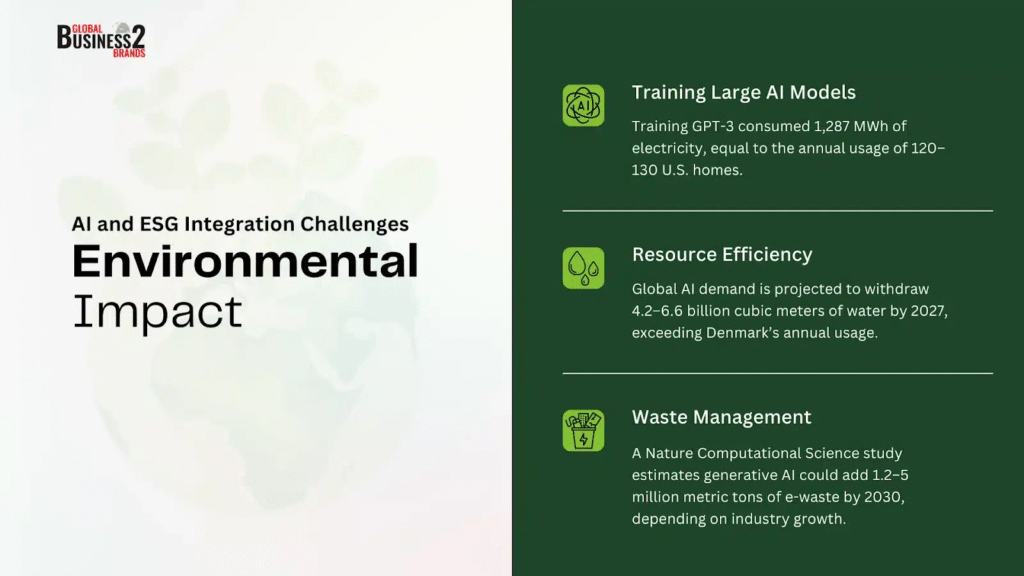
- Social Challenges: While AI offers groundbreaking opportunities for the business world, it’s not without risks. AI may inadvertently perpetuate and accentuate biases and inequality. Additionally, it can exacerbate socioeconomic inequality by favoring more affluent or technologically sophisticated regions.
- Governance Challenges: Legal ambiguity results from the quick growth of AI technologies, which frequently surpasses the creation of regulatory frameworks.
- Data Privacy Concerns: AI systems heavily depend on large datasets that contain sensitive personal information. Ensuring the privacy and security of this data is crucial since the lack of strong data governance policies can result in data breaches that cause identity theft, financial crime, and a deterioration in public trust.
- Skill Gaps and Organizational Readiness: Successful integration of ESG principles in AI models requires a proficient workforce trained in both AI technologies and ESG principles. However, significant gaps4 in competence have been noted among sustainability professionals, particularly with regard to AI technologies. The successful application of ESG-aligned AI technologies may be hampered by this disparity.
Strategic Framework for ESG-Aligned AI
Environmental Sustainability
Companies should strive for environmental sustainability in AI, by:
- Optimizing AI energy consumption by using efficient algorithms and sustainable data centers.
- Harness the power of green computing by utilizing cloud services powered by renewable energy.
- Streamline AI models to balance performance with sustainability.
Social Responsibility & Fair AI
Ethical AI should prioritize fairness and inclusivity, by:
- Implementing regular audits to detect and mitigate bias in datasets.
- Bolster accessibility by ensuring that AI tools cater to diverse user needs, including underrepresented groups.
- Enhance human-AI collaboration by complementing human intelligence.
Governance & Compliance in AI
CXOs should spearhead the maintenance and adoption of ethical AI governance in organizations, by:
- Developing and implementing frameworks for responsible development of AI.
- Enhance transparency in AI decision-making and auditing. For example, the opaque nature of some AI decision-making processes, often referred to as “black-box” models, raises concerns about transparency and accountability.
- Ensuring compliance with international regulatory frameworks.
Key Metrics to Measure ESG in AI
ESG metrics use ESG issues to measure performance. They assist your company in accurately and scientifically assessing the results of your ESG initiatives. The definitions and regulations around ESG are constantly evolving so one wouldn’t find universal metrics. However, organizations like the World Economic Forum5 are trying to create a common metric for consistent reporting.
Here are a few key metrics for CXOs to consider:
| 📊 Carbon Footprint Reduction – Lower AI-related energy consumption. |
| 📊 Diversity in AI Training Data – Ensure representation across all demographics. |
| 📊 Regulatory Compliance Score – Adhere to evolving AI ethics laws. |
A Roadmap to Responsible Innovation
The substantial amount of energy consumption in AI systems and models development and training is indubitably a palpable concern. CXOs at the helm of the AI revolution must integrate ESG principles for long-term sustainable benefits. Remember, in light of growing environmental awareness, ESG compliance is imperative for major businesses.
Only by prioritizing sustainability, fairness, and governance, Organizations can unlock ethical innovation, enhance trust, and drive long-term success in the AI-driven world.
A Roadmap to Responsible Innovation
1. https://blogs.microsoft.com/blog/2020/01/16/microsoft-will-be-carbon-negative-by-2030/
2. https://sustainability.google/operating-sustainably/net-zero-carbon/
5. https://www3.weforum.org/docs/WEF_IBC_Measuring_Stakeholder_Capitalism_Report_2020.pdf
ESG and Women Leadership: Driving Sustainability & Inclusion
By Dr Renuka Thakore
The world is witnessing a critical juncture in sustainability, with Environmental, Social, and Governance (ESG) frameworks becoming fundamental to business strategy. Yet, the role of women in advancing sustainability and ESG leadership remains vastly underrepresented. While more women are graduating from universities than ever before, their progression into senior research, decision-making, and leadership roles remains alarmingly low—women make up over 50% of graduates but hold only 28% of senior leadership positions globally. This glaring disparity highlights the need for urgent interventions to foster gender-inclusive sustainability leadership.
The Gendered Impact of Environmental Degradation
Environmental challenges disproportionately affect women due to their social roles, economic vulnerabilities, and cultural constraints. When climate-related disasters strike, it is women—especially those in rural and low-income communities – who bear the brunt.

- Fuel Poverty & Energy Access: Women in many parts of the world are still responsible for household energy needs. In Africa, nearly 600 million people lack electricity, and women spend over 200 million hours daily collecting firewood, exposing them to health hazards and limiting economic opportunities.
- Pollution & Health Risks: Women working in manufacturing and agriculture are frequently exposed to pollutants, pesticides, and toxic waste, leading to increased respiratory diseases, reproductive issues, and long-term illnesses.
- Water & Food Scarcity: Climate-induced droughts and erratic rainfall patterns jeopardise food security—and since women account for 43% of the global agricultural workforce, their livelihoods and nutritional well-being are at significant risk.
Women in ESG Governance: The Representation Gap
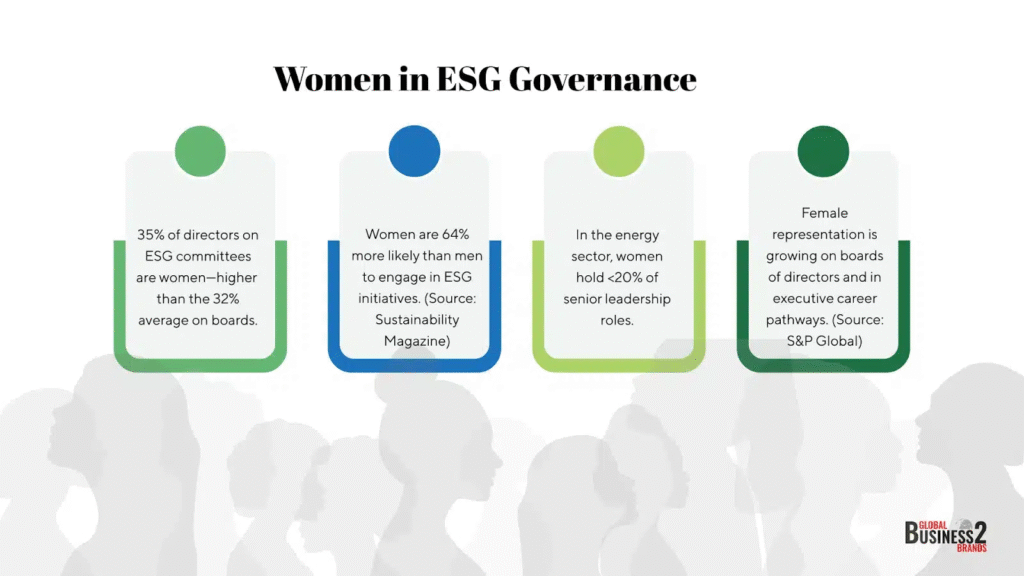
Despite the growing importance of sustainability-driven governance, women’s voices remain significantly underrepresented in leadership roles across corporations, policy-making institutions, and governance structures. Currently, women hold just 10–30% of governance positions across corporate boards, political offices, and regulatory bodies. In many cases, women are included merely for symbolic representation, akin to greenwashing in environmental policies – an illusion of progress rather than real impact.
This lack of representation results in ESG policies that overlook the nuanced gender-specific challenges within sustainability strategies, making it even more critical to prioritise women’s leadership and equity in ESG frameworks.
Breaking Barriers: Strategies for Inclusive ESG Leadership
To truly embed gender equity into sustainability leadership, a multi-stakeholder approach is required – ranging from corporations and policymakers to communities and academic institutions. Here are some key strategies to turn the tide:
Inclusive Workforce & Policy Reforms
Workplace policies that uphold gender equity and remove systemic barriers are a prerequisite for building a sustainable tomorrow.
- Establish workplace policies that support female employees, including maternity leave, childcare support, and menstrual hygiene facilities.
- Ensure equal pay and equitable career growth pathways in sustainability-driven industries such as agriculture, construction, and manufacturing.
Empowering Women in Agriculture & Land Ownership
Women’s participation in agriculture is vital for food security and environmental sustainability, yet they face significant barriers to ownership and investment.
- Advocate for land rights reforms to ensure women have ownership and decision-making power in agricultural sustainability.
- Provide microfinancing and investment opportunities tailored for women-led agribusinesses and green enterprises.
AI & Tech Equity in Sustainability
The impact of AI, which has emerged as a key component driving ESG activities, is contingent upon the fairness and diversity of the data it is trained on.
- AI and digital transformation are shaped by existing patterns, and if these patterns lack gender diversity, AI will reinforce inequalities.
- A conscious effort is needed to develop AI-driven ESG solutions that actively incorporate diverse data inputs, ensuring fair and inclusive decision-making.
Female Representation in Governance & Decision-Making
Diverse leadership leads to more inclusive, effective, and sustainable policies, making it essential to amplify women’s voices in decision-making roles.
- Increase women’s participation in corporate ESG committees, government sustainability councils, and UN climate leadership platforms.
- Implement mentorship and sponsorship programs that help women rise to senior leadership in sustainability sectors.
Behavioural & Cultural Change
Shaping a more sustainable and equitable future requires challenging deep-rooted biases and fostering inclusive mindsets from an early stage.
- Foster gender-sensitive education and community programs that challenge stereotypes and promote women’s active roles in sustainability.
- Encourage family and social structures to support female leadership from an early stage.
Closing the Gender Gap in ESG & Sustainability
The current ESG landscape cannot drive meaningful and lasting change without gender equity. Women must not only be included in sustainability governance but empowered to lead – because their perspectives, experiences, and expertise are essential for holistic, impactful, and just sustainability solutions.
By integrating gender-inclusive policies, leveraging AI for equitable decision-making, and reforming governance structures, we can pave the way for a truly sustainable and inclusive future.
The time for action is now – because sustainability without gender equity is simply unsustainable.
The Hidden Power of Women Leaders: Driving Change in Business and Society
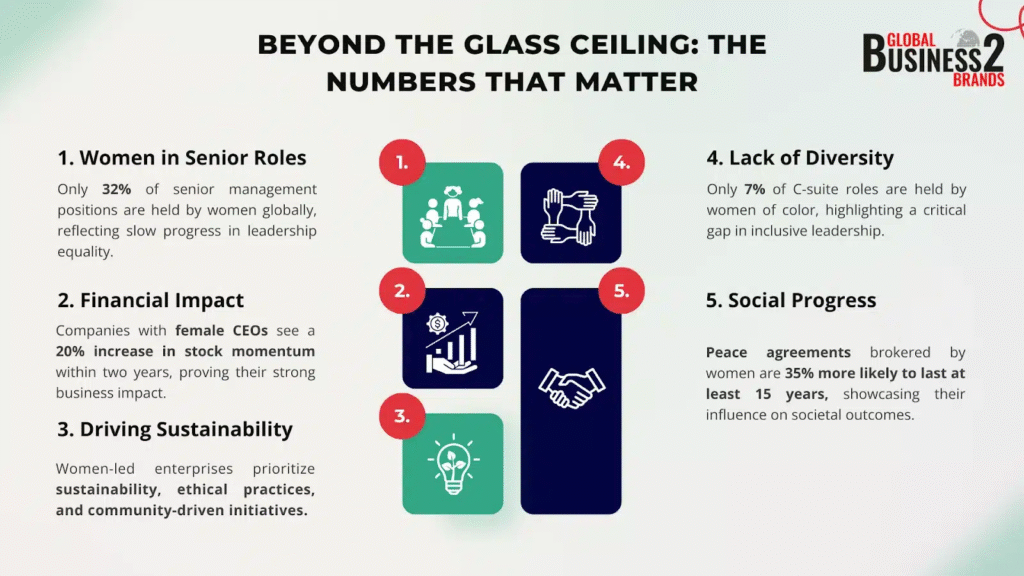
Women in leadership positions have long been a subject of debate, yet the numbers remain unimpressive. With only 32% of senior management positions held by women globally, the glass ceiling persists. The question is no longer whether women belong in leadership, but rather why their rise to the top remains disproportionately slow despite clear evidence of their impact.
Women in Leadership: More Than a Diversity Checkbox
The discussion around women leaders often centres on diversity metrics, but the real value extends far beyond quotas. Research has proven that organizations with women in senior roles not only achieve better financial performance but also foster more innovative and inclusive workplace cultures. Female leaders introduce fresh perspectives, challenge outdated norms, and drive meaningful social change within their communities.
Yet, despite these advantages, women continue to face systemic barriers. From unconscious biases in recruitment and promotions to the persistent “broken rung” that prevents them from advancing to managerial roles, the corporate pipeline remains riddled with obstacles. The situation is even more dire for women of colour, who occupy only 7% of C-suite positions, making the path to leadership even more arduous.
The Financial and Social Impact of Women Leaders
The benefits of women in leadership are tangible and measurable. Companies with female CEOs and CFOs see a significant increase in profitability and stock performance. For instance, firms with a woman at the helm experience a 20% rise in stock price momentum within two years, and businesses with more women on boards report a 21% higher profitability rate.
Beyond corporate success, female leadership directly influences social progress. Women-led enterprises prioritize sustainable practices, ethical business decisions, and community-driven initiatives. Female executives and policymakers are more likely to champion policies that enhance education, healthcare, and economic opportunities for marginalized groups. Evidence suggests that peace agreements brokered by women have a 35% higher chance of lasting at least 15 years. Similarly, female political leaders have been instrumental in driving healthcare reforms and reducing gender disparities in economic participation.
Why Leadership Is Still a Battle for Women
Despite these compelling statistics, progress remains slow. Women in leadership face higher performance expectations and harsher criticism compared to their male counterparts. The “double standards of competence” model suggests that while men are promoted based on potential, women must repeatedly prove their capabilities before being considered for top positions. Additionally, societal norms continue to frame leadership as a male domain, reinforcing outdated stereotypes that hinder women’s advancement.
Maternity discrimination also plays a significant role in slowing women’s leadership progress. Many women encounter the “maternal wall,” where their career trajectories are assumed to stall due to motherhood. The expectation that women should balance work and family while maintaining high professional performance remains a significant challenge that male leaders rarely face.
Breaking the Barriers: What Needs to Change
If companies and societies genuinely want to benefit from female leadership, they must take deliberate actions to remove systemic barriers. Implementing structured mentorship programs, eliminating unconscious bias in recruitment, and creating transparent career advancement pathways are essential steps. Data-driven approaches to diversity and inclusion can also help identify and rectify gender disparities within organizations.
Workplace flexibility is another critical factor. Companies that offer genuine flexible work arrangements see higher retention rates of women in leadership roles. When organizations move beyond token representation and work towards achieving a critical mass of female leaders across all departments, they foster a culture of inclusivity and long-term success.
Women Leaders as Agents of Change
The influence of female leaders extends beyond corporate settings and into the realm of social impact. Women-led initiatives have transformed communities by improving access to education, healthcare, and economic opportunities. Female entrepreneurs are also outpacing their male counterparts in business creation, with women-owned businesses growing at a faster rate worldwide.

Programs focused on mentorship and leadership training for young women are crucial in preparing the next generation for success. Organizations that prioritize gender diversity in leadership are not just making a moral choice—they are making a strategic one. Companies with diverse leadership teams see higher employee engagement, greater innovation, and better long-term financial performance.
A Call to Action
Women have proven time and time again that they are not only capable leaders but also transformative agents of change. Yet, achieving true leadership equality requires more than acknowledgment—it demands action. Organizations must actively support female leadership development, implement unbiased hiring and promotion practices, and create environments where women can thrive without barriers.
The evidence is clear: societies and businesses that empower women leaders experience greater success, sustainability, and social progress. The question is no longer if women should lead, but how soon we can dismantle the structures that prevent them from doing so at equal rates as men. The future of leadership must be inclusive, dynamic, and equitable—and that future starts now.