What Is a Carbon Credit? A carbon credit represents one tonne of greenhouse gas emissions that has been reduced, avoided or removed — and independently verified. Credits are generated by activities such as forest protection, renewable energy, methane capture and energy-efficiency projects. Once verified, a credit becomes a tradable unit. It can be bought, sold […]
A carbon credit represents one tonne of greenhouse gas emissions that has been reduced, avoided or removed — and independently verified. Credits are generated by activities such as forest protection, renewable energy, methane capture and energy-efficiency projects.
Once verified, a credit becomes a tradable unit. It can be bought, sold or held by companies, governments and individuals and ultimately used — or “retired” — to support a specific climate claim such as offsetting a portion of an organisation’s emissions.
Credit vs. Market
Voluntary vs. Compliance Markets
Key principle: Once a credit is used for an eligible claim, it is retired in the registry and cannot be reused or resold.
A project earns the right to issue carbon credits by moving through a defined chain of evidence — from design through independent verification. Skipping or weakening any stage puts the credibility of the resulting credits at risk.
This is the case a project must build — the proof behind a credit’s claim. It is distinct from the credit lifecycle on the next page, which is the procedural journey a project moves through, from design to a retired credit.
Each layer builds on the one before it — weak evidence at any stage undermines the credit’s credibility, no matter how solid the rest of the case looks.
In practice, this evidence chain is what a buyer, auditor or registry checks before trusting a credit’s claim: which methodology was used, what baseline was assumed and whether the monitoring data supporting it is complete and traceable.
Once that case is built, the project moves through a broadly consistent lifecycle on its way from concept to a retired credit — the same journey underlying every credit you may see referenced in a sustainability report, product claim or offset purchase:
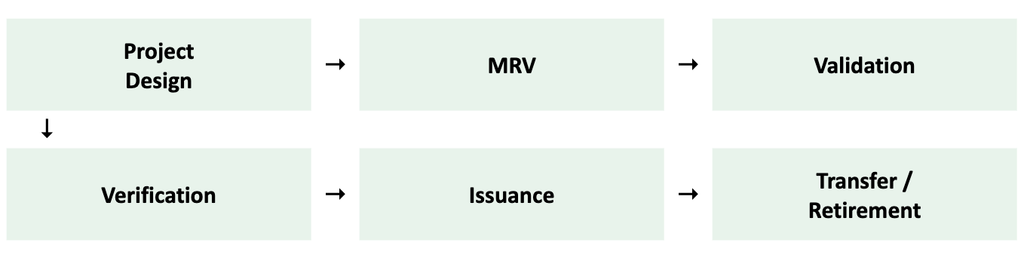
The lifecycle is different from the carbon case: the carbon case establishes why and how much climate impact can be claimed; the lifecycle describes how that claim moves through the programme toward an issued and potentially retired credit.
This is the broad pattern most credits follow — the exact stages, sequencing and terminology vary by carbon standard or programme (e.g. CDM, Gold Standard, GCC, Verra/VCS).
Understanding where a credit sits in this lifecycle — issued but not yet retired, for example — is often the first useful question to ask when reviewing any carbon claim.
Validation confirms a project’s design meets the requirements of the applicable standard before it proceeds; verification confirms, afterwards, that the project actually delivered the emission reductions it claims. The exact process and terminology depend on the applicable carbon standard or programme, so the same words can mean slightly different things across CDM, Gold Standard, GCC and Verra/VCS.
Before a project can move through the lifecycle on the previous page, it needs to clear a set of basic readiness questions. Use this as a first-look gauge — not a substitute for full technical or legal due diligence:
| Is the project activity eligible under an applicable carbon standard? | ☐ |
| Does the project go beyond business-as-usual (additionality)? | ☐ |
| Is a suitable methodology and baseline identified? | ☐ |
| Can emission reductions be measured and monitored reliably (MRV)? | ☐ |
| Is project documentation complete and traceable? | ☐ |
| Are ownership and carbon rights clearly established? | ☐ |
| Can the project pass validation and independent verification? | ☐ |
For renewable-energy projects, installed capacity alone does not establish carbon-credit eligibility, methodology, baseline, additionality and reliable monitoring data need to support the carbon case.
Even projects that look strong on paper can stall at verification — the detailed pitfalls to watch for and how to check for them, are covered in the next article.
A carbon project may look straightforward at first — but determining whether its emission reductions are eligible, quantifiable, additional and verifiable requires a closer look at the evidence behind the project.
Our next piece on carbon credits goes deeper into the questions behind this first-level assessment, including methodology selection, baseline and additionality considerations, MRV evidence, documentation readiness and verification risks.
Browse our full library of articles, reports, and resources.
